

In this article
Flea treatment for cats usually starts with a small discovery: your cat keeps scratching at the base of the tail, or you find black specks on the bed and wonder how a cat who barely goes outside picked up fleas at all. The fleas on your cat are only the visible end of a cycle that runs in your carpet, couch, and bedding. At Liberty Animal Hospital, a veterinarian near me in Salem can confirm fleas, choose a product that is safe for cats, and plan how to clear the house. This guide covers the flea life cycle, signs and health risks, safe treatment, and booking in South Salem.
What Is Flea Treatment for Cats?
Flea treatment for cats is a veterinary plan that kills the fleas living on your cat, stops the eggs they lay from developing, and keeps new fleas from settling in while your home clears. It is not one bath or one spot-on. The Cornell Feline Health Center is plain about why: treating the animal without treating its surroundings will not solve the problem, because most of a flea's development happens off the cat. That is also why the plan usually includes every dog and cat in the house, not only the one you caught scratching.
At our South Salem clinic, cat flea treatment near me starts with an exam. We confirm that fleas are the cause, check the skin for allergy or infection, and weigh your cat's age, weight, health, and household before choosing a product. We stock oral, topical, and other forms, and Dr. Kolby Virgin matches them to what your cat will tolerate and what you will remember to give. You can usually leave with the first dose from our pharmacy.
What flea treatment can and cannot do
Flea treatment can kill adult fleas on your cat, cut off the egg supply, and ease the itch and skin damage fleas leave behind. It cannot reach pupae sealed in their cocoons, which is why a few new fleas can keep appearing for weeks after the first dose.
- It can kill the adult fleas living on your cat and stop them from breeding.
- It can include ingredients that stop flea eggs and larvae from developing in your home.
- It cannot kill pupae inside their cocoons, so new fleas can hatch for a while.
- It cannot hold if a dog or second cat in the house stays untreated.
- It does not mean a dog flea product is safe for your cat. Many are not.
The Flea Life Cycle: Egg, Larva, Pupa, and Adult
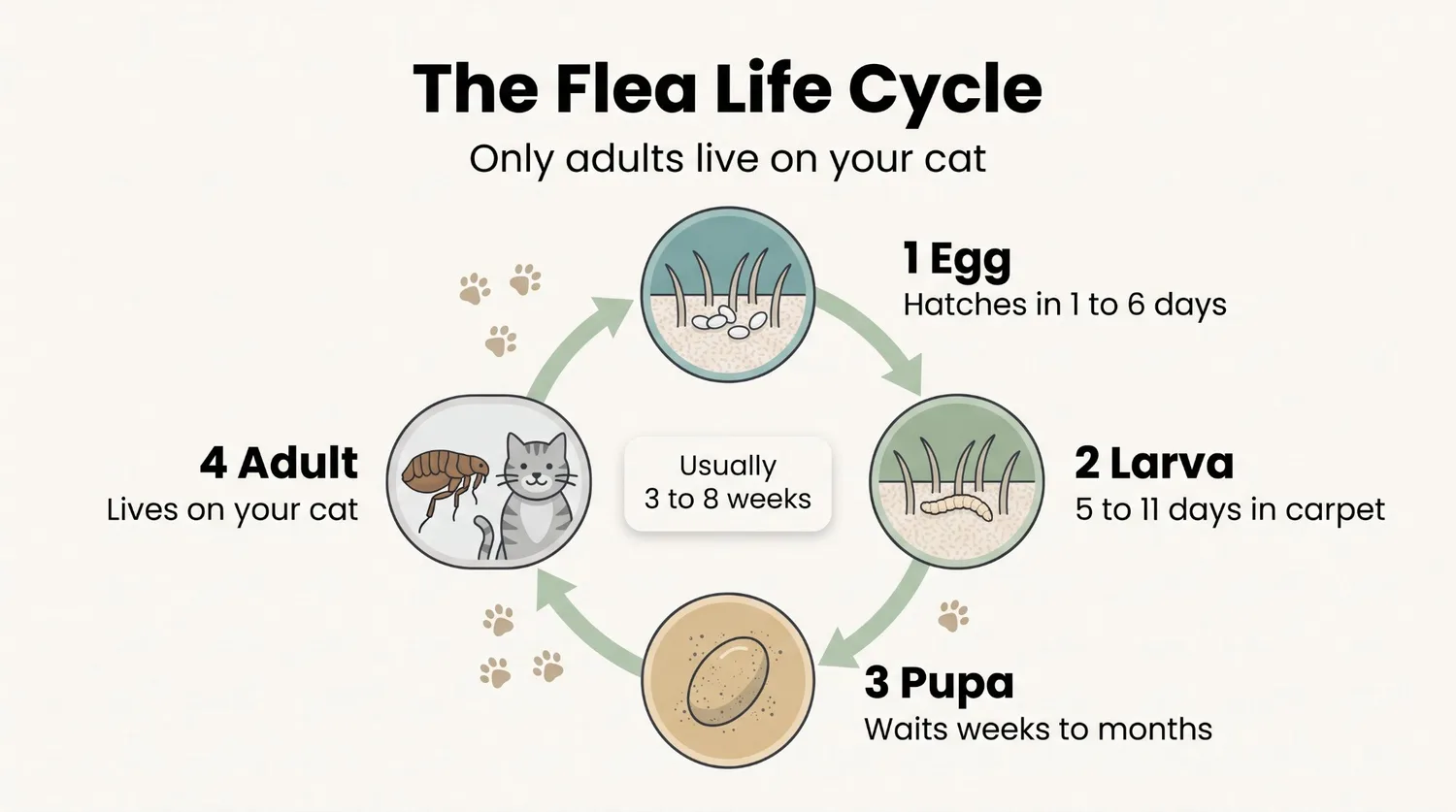
The flea life cycle has four stages, egg, larva, pupa, and adult, and only the adult lives on your cat. Nearly all flea problems in cats come from one species, the cat flea (Ctenocephalides felis), which the Companion Animal Parasite Council (CAPC) lists as the most common external parasite of cats in North America. The Merck Veterinary Manual says the full cycle can finish in as little as 12 to 14 days, usually takes three to eight weeks, and can stretch to almost a year when it is cool or no host is around.
In our short flea video, Dr. Kolby Virgin puts it simply: the fleas you see are only about 5 percent of the problem. The rest are eggs, larvae, and pupae in your carpet, couch, and bedding. That is why a single product rarely ends an infestation on its own.
Stage 1: Flea eggs
Flea eggs are pearly white ovals about half a millimeter long that a female lays on your cat, and CAPC notes they drop off into the house shortly after they are laid. A female starts laying within a day or two of her first blood meal and can produce up to 50 eggs a day, about 2,000 in her lifetime, according to Merck. They hatch in one to six days.
Stage 2: Flea larvae
Flea larvae are tiny, pale, worm-like creatures that hatch from the eggs and hide in carpet, under furniture, along baseboards, and in pet bedding. They avoid light and feed on flea dirt, the dried blood that adult fleas pass. Merck says the larval stage usually lasts five to eleven days and can stretch to two or three weeks. Larvae die in dry air, and the damp Willamette Valley rarely gets dry enough to stop them.
Stage 3: Flea pupae
Flea pupae are larvae sealed inside sticky silk cocoons, and they are the hardest stage to get rid of. The adult inside can finish developing in one to two weeks, then wait for weeks or months until it senses a host. CAPC lists the triggers: pressure, carbon dioxide from breath, and warmth. Cornell adds that pupae cannot be killed with insecticides, freezing, or drying, which is why new fleas keep appearing after treatment starts.
Stage 4: Adult fleas
Adult fleas are the dark, fast-moving insects you find in your cat's fur, and once one jumps aboard it starts feeding almost at once and usually stays. CAPC says most adult cat fleas survive two to three months on a host, while a newly hatched flea that finds no host usually dies within one to two weeks.
How Cats Get Fleas, Even Indoors
Cats get fleas when a newly hatched adult flea jumps on from the environment, and that environment can be a yard, a porch, another pet, or your own living room. The Cornell Feline Health Center notes that wildlife such as raccoons and skunks can seed a yard with fleas, and that adult fleas readily hop onto any animal passing by.
The indoor-only myth
The indoor-only myth is the belief that a cat who never goes outside cannot get fleas. Indoor cats get fleas too. In our flea video, Dr. Kolby Virgin explains that fleas hitchhike in on people and other pets, or come through window screens. A pupa can also sit in a carpet left by a previous resident's pet and hatch when a new cat moves in, because warmth, breath, and footsteps are exactly the signals it waits for.
Why fleas last all year in Salem
Fleas last all year in Salem because our winters are mild and damp and our homes are heated, so the indoor part of the cycle never really stops. The Merck Veterinary Manual notes that fleas in every stage die only when temperatures stay below 37°F for several days. Salem winters rarely stay that cold for days at a time, and a heated living room never does. That is why our team sees flea problems in January as often as July, and why CAPC recommends treating all cats year-round, for life, rather than only in summer.
Signs Your Cat Has Fleas
The clearest sign your cat has fleas is scratching, licking, or chewing that keeps going, especially around the neck, the lower back, and the base of the tail. Cats are such thorough groomers that they often swallow fleas before you see one, so a clean-looking coat does not rule them out. The Merck Veterinary Manual describes a simple home check: comb your cat over a damp white paper towel. Flea dirt, which is digested blood, dissolves into reddish-brown smears. Ordinary dirt stays black.
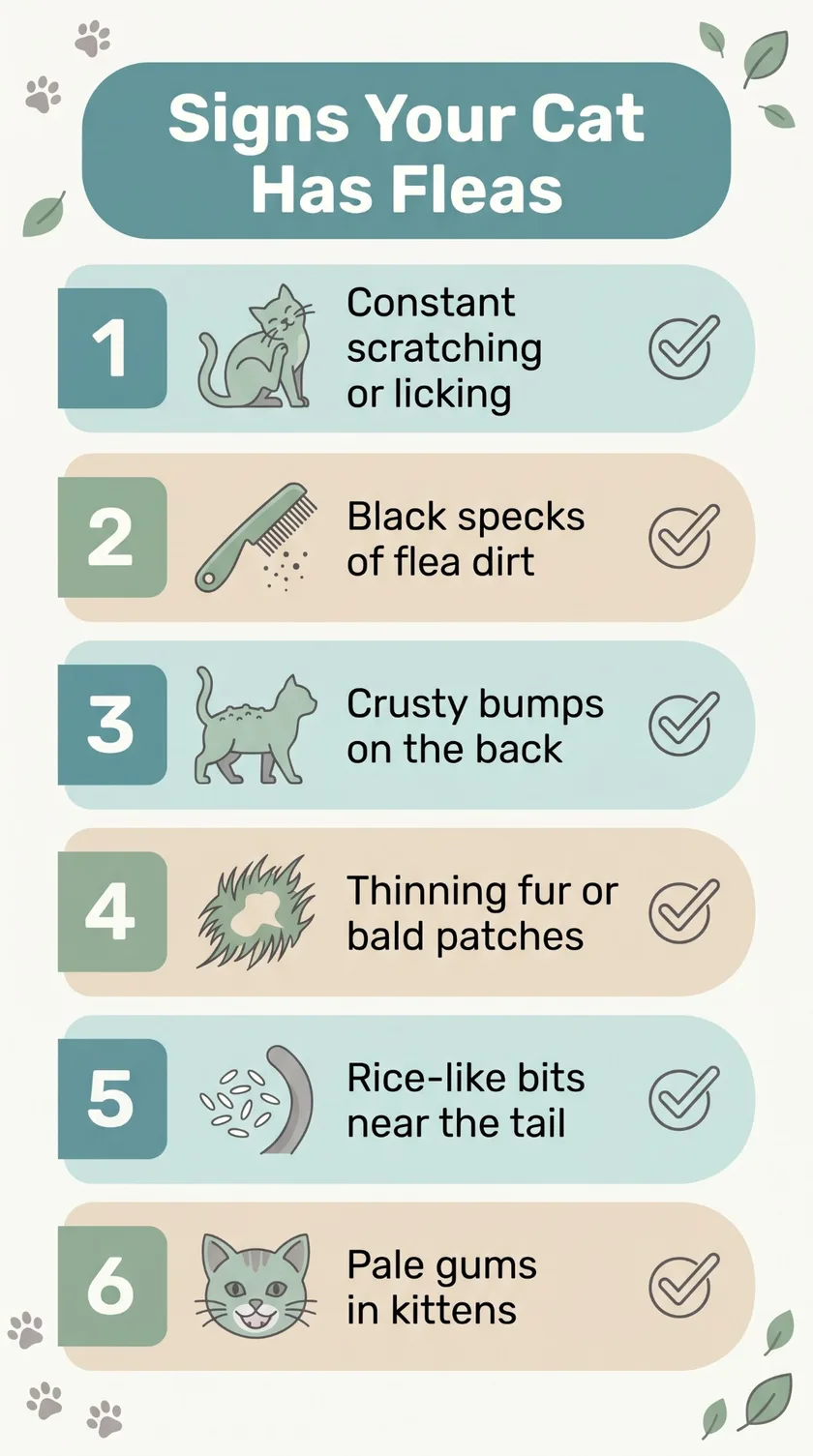
- Scratching, overgrooming, or chewing at the neck, back, or base of the tail
- Black, comma-shaped specks of flea dirt in the fur or on bedding
- Small crusty bumps on the back, neck, or face
- Thinning fur or bald patches, often along the back
- Rice-like tapeworm segments near the tail or in the litter box
- Pale gums, weakness, or low energy, especially in a kitten
- Itchy bites on people in the house, often around the ankles
Call the same day if a kitten with fleas seems weak, will not eat, or has gums that look pale instead of pink, because heavy infestations can cause anemia. Also call right away if your cat drools, twitches, trembles, or has a seizure after any flea product is applied. If that happens after hours, go to an emergency hospital. The one we direct clients to is WilVet Salem Emergency, (503) 741-8858.
Health Problems Fleas Cause in Cats
Fleas cause more than itching in cats: they can trigger a skin allergy, spread tapeworms, drain enough blood to make a kitten anemic, and carry bacteria that can make people sick. CAPC lists all of these as risks of the cat flea, and how serious they get depends on how many fleas there are and how young or sensitive your cat is.
Flea allergy dermatitis
Flea allergy dermatitis is an allergic reaction to proteins in flea saliva, and it makes a cat itch far more than the number of bites would suggest. Merck describes small crusty bumps called miliary dermatitis, mostly on the back, neck, and face, and sometimes a band of hair loss along the spine. Finding fleas does not rule out a second cause, such as food allergy. Allergic cats may need medicine for the itch and any infection while flea control takes hold, which our dermatology workups cover.
Tapeworms
Tapeworms reach cats when a cat swallows an infected flea while grooming, so a cat with fleas can end up with worms as well. The flea tapeworm, Dipylidium caninum, is one of the parasites CAPC lists as spread by cat fleas. You may notice small, rice-like segments near the tail or in the litter box. A dewormer clears the worm, but a cat can be reinfected the next time it swallows a flea, so we treat the two together.
Anemia in kittens
Anemia in kittens happens when a heavy flea load drains more blood than a small body can replace. The Cornell Feline Health Center notes that flea anemia mainly affects kittens, and CAPC warns that heavy infestations can cause iron deficiency anemia and even death in young animals. Flea products carry minimum ages and weights on their labels, so a young kitten needs a product chosen by a veterinarian, which is part of our kitten care visits.
Diseases that can reach people
Cat fleas can carry bacteria that affect people, including Bartonella henselae, the cause of cat scratch disease, and the rickettsial bacteria behind flea-borne typhus, according to CAPC. That is one more reason to treat every pet and the house, especially when someone at home is very young, elderly, or immune-compromised. Questions about your own health belong with your doctor.
How Flea Treatment for Cats Works at the Clinic
Flea treatment for cats at the clinic works in three parts: an exam, a product chosen for your cat, and a plan for the rest of the household. If you are not sure whether the itch is fleas, allergy, or something else, the exam is the right first step, because the treatments differ.
The exam
The exam is where we confirm fleas and check what they have done to the skin. We comb and part the coat, look for flea dirt, scabs, hair loss, and infection, and check gum color in kittens or heavily affected cats. We ask about every animal in the house, who goes outside, and what has already been tried. A stool check for intestinal parasites, or bloodwork through our in-house laboratory when anemia is a concern, may be part of the visit.
Choosing a safe product
Choosing a safe product means matching it to your cat's species, weight, age, health, and lifestyle. Options include oral and topical products, and some also cover intestinal worms or heartworm. Some include an insect growth regulator, an ingredient that CAPC says stops flea eggs from hatching and kills larvae, which helps break the cycle in your home. We dispense what we recommend from our pharmacy, and refills there keep coverage from lapsing between visits.
Never use a dog flea product on a cat
Never use a dog flea product on a cat, even a small amount. Many dog spot-ons contain permethrin, an insecticide cats cannot break down. The Feline Veterinary Medical Association (formerly the American Association of Feline Practitioners) reports that dog permethrin products typically contain 45 to 60 percent permethrin, compared with less than 0.1 percent in products marketed for cats, and that exposure can cause drooling, tremors, seizures, and death. Cats can also be poisoned by grooming a dog that was just treated, so keep them apart and ask us which dog products are safe in a home with cats.
Treating Your Home to Break the Flea Cycle
Treating your home breaks the flea cycle by removing eggs, larvae, and pupae before they become the next wave of adults. Most of the work is cleaning, done often, for the same two to three months you treat the pets. Cornell also recommends washing all bedding and vacuuming frequently, and notes that vacuuming also coaxes pupae out of their cocoons, where treatment can reach them.
- Vacuum carpets, rugs, upholstery, and under furniture daily at first, starting where your cat sleeps.
- Empty the vacuum canister or bag outside the house each time.
- Wash cat beds, blankets, throws, and carrier pads in hot water, and repeat often.
- Treat every dog and cat in the house on the same schedule, even pets with no visible fleas.
- Ask us before using any home spray or fogger, and use only products your vet says are safe around cats.
- Outdoors, focus on shady, damp spots such as under decks and porches, not the sunny lawn.
Consistency matters more than intensity, because a skipped dose or one untreated pet gives the cycle a way back. Once the house is clear, monthly prevention all year keeps the cycle from starting again.
Flea Treatment for Cats Compared With Flea Prevention
Flea treatment for cats clears an infestation that is already in your home, while flea prevention keeps a flea-free cat and house from getting one. The table below shows how the two generally compare.
| Criterion | Flea treatment | Flea prevention |
|---|---|---|
| Goal | Clear fleas already on the cat and in the home | Stop new fleas from settling in |
| Who needs it | Every pet in the house, plus the home itself | Every pet in the house |
| How long | Usually two to three months, sometimes longer | All year, for life |
| Home cleaning | Daily vacuuming and hot washes at first | Normal cleaning |
| What you may see | A few new fleas for several weeks | Usually no fleas at all |
| Vet visit | Exam to confirm fleas and check the skin | Product review at wellness visits |
The same monthly product that clears an infestation is usually what keeps it from coming back, so treatment becomes prevention once the house is clear. If your cat is due for a wellness exam, that visit is a good time to check that the product, dose, and schedule still fit.
Booking Flea Treatment for Cats in Salem
Booking flea treatment for cats in Salem starts with a call to (503) 339-7065 or a request to book an appointment online. Tell us how many dogs and cats live in the house, whether any go outdoors, and which products you have already used, so we can plan enough doses for everyone. If your cat hates the carrier, say so when you book so we can plan the visit around that.
Liberty Animal Hospital cares for cats from Salem, South Salem, Keizer, Turner, and Independence in the Sunnyslope Center on Liberty Rd S. If a kitten is weak, your cat's gums look pale, or your cat drools or trembles after a flea product, call and ask whether we can see them as pet urgent care near me or whether you should go straight to emergency care. For an emergency we cannot see, use WilVet Salem Emergency, (503) 741-8858.
Fleas are not the only problem cats hide well. Our guide to feline dental care covers the mouth pain cats rarely show, and if you are new to the area, our guide to choosing the best vet near me in Salem walks through what to check.
Flea treatment for cats in Salem works best when it treats the whole flea life cycle, not just the flea you can see.
Frequently Asked Questions
How long does flea treatment for cats take to work?
Flea treatment for cats usually starts killing the fleas on your cat within a day, but clearing the whole home typically takes two to three months, according to the Merck Veterinary Manual. New fleas keep hatching from cocoons in carpet and bedding during that time, so seeing a few is expected. If you still see many fleas after the first month, or the itch is worse, call us to review the plan.
Can I use dog flea treatment for cats in a pinch?
Dog flea treatment is not safe to use on cats, even in a pinch, because many dog products contain permethrin at strengths cats cannot break down. The Feline Veterinary Medical Association reports that dog permethrin products typically contain 45 to 60 percent permethrin, compared with under 0.1 percent in cat products. Signs of poisoning include drooling, twitching, tremors, and seizures. If your cat shows any of them after a flea product, call us right away or go straight to an emergency hospital.
How much does flea treatment for cats cost?
Flea treatment for cats does not have one flat price, because the total depends on your cat's weight, the product, how many pets need doses, and whether the skin needs treatment of its own. We give you an estimate after the exam. Skipping a pet to save money can mean paying to start over when that pet reseeds the house. If budget is a concern, tell us when you call so we can weigh the options together.
Is flea treatment for cats safe for kittens?
Flea treatment for cats can be safe for kittens when the product is labeled for that kitten's age and weight, which is why a veterinarian should choose it. Flea products carry minimum ages and weights on their labels, and a product that suits an adult cat may not suit a young kitten. Kittens are also the cats most at risk of anemia from fleas, so a flea-covered kitten who seems weak or has pale gums should be seen the same day.
Why do I still see fleas after flea treatment for cats?
You may still see fleas after flea treatment for cats because new adults keep hatching from cocoons in your home for weeks, and the cocoon stage resists most treatments. Those fleas jump onto your treated cat and die, though some feed for a few hours first. Keep every pet on schedule, vacuum often, and wash bedding hot. Fewer fleas each week means the plan is working. Call us if the numbers are not dropping after about a month.
When should I call a vet about flea treatment for cats in Salem?
Call a vet about flea treatment for cats in Salem as soon as you find fleas or flea dirt, notice rice-like segments near the tail, or see scratching and scabs that do not settle. You can reach Liberty Animal Hospital at (503) 339-7065. Call the same day if a kitten is weak or has pale gums, or if your cat drools, twitches, or trembles after any flea product. If that happens after hours, go to an emergency hospital rather than waiting.
Sources
- Cornell Feline Health Center, Fleas: A Source of Torment for Your Cat
- Companion Animal Parasite Council, Fleas (cat guidelines) (updated September 19, 2017)
- Merck Veterinary Manual, Pet Owner Version, Fleas of Cats (updated March 2026)
- Feline Veterinary Medical Association (catvets.com), Permethrin Poisoning and Cats
- Cornell Riney Canine Health Center, Fleas
Links checked October 28, 2026. This article is general information, not a diagnosis; call your veterinarian about your own pet.