
In this article

The difference between spay and neuter comes down to your pet's sex: a spay is the operation for a female dog or cat, and a neuter is the operation for a male. Both prevent litters and remove the main source of sex hormones, but they're different surgeries with different recoveries. If you've been looking for a veterinarian near me in Salem, Liberty Animal Hospital is a dog and cat clinic in South Salem, and we spay and neuter dogs and cats. This guide covers what each surgery involves, which one your pet needs, the timing vets recommend, and what recovery looks like at home.
What Is the Difference Between Spay and Neuter?
The difference between spay and neuter is which reproductive organs come out: a spay removes a female's ovaries and usually her uterus, and a neuter removes a male's testicles. Both are done under general anesthesia, and both end the ability to have litters. The American Veterinary Medical Association (AVMA) calls them major surgical procedures, but also the most common surgeries vets perform on dogs and cats.
What happens in a spay
In a spay, the vet removes a female's reproductive organs through an incision in the belly. The usual version is an ovariohysterectomy, which removes the ovaries, fallopian tubes and uterus. A less common version, an ovariectomy, removes only the ovaries, and the AVMA says its effect is similar. Either way, heat cycles stop.
What happens in a neuter
In a neuter, the vet removes both of a male's testicles, which stops sperm production and removes the main source of testosterone. Its formal name is orchiectomy or castration, and you'll also hear “neuter” used loosely for both sexes. Because the testicles normally sit in the scrotum, the vet doesn't need to open the belly. Cornell's Feline Health Center describes the cat neuter as quicker and less complicated than a spay.
What spaying and neutering can and can't do
Spaying and neutering can protect your pet from some serious diseases, but they aren't a fix for everything:
- They prevent litters, the main reason most owners choose them.
- Spaying prevents uterine infections and ends heat cycles.
- Neutering removes the risk of testicular cancer.
- They often reduce roaming and urine marking, especially in males.
- They don't replace training, and they can make weight gain more likely.
Which One Does Your Pet Need?
Your pet needs a spay if she's female and a neuter if he's male, so your pet's sex makes that choice for you. The decisions that are really yours, made with your vet, are whether to sterilize and when. The American Animal Hospital Association (AAHA) says the reasons to spay or neuter far outweigh the risks of not doing so, and the AVMA encourages owners to weigh the benefits and risks with their veterinarian.
If you're not sure your pet is already fixed
If you're not sure your pet is already fixed, check the adoption paperwork first, because many shelters and rescues spay or neuter before adoption. Without records, your vet can look for a surgical scar. For males, Cornell's Riney Canine Health Center notes that hormone blood tests can confirm whether testicles are still present. For females, tell your vet if you see heat signs such as bloody discharge, yowling or unusual restlessness.
When a neuter is more involved: retained testicles
A neuter is more involved when a testicle never drops into the scrotum, a condition called cryptorchidism. According to Cornell, a retained testicle can sit in the groin or inside the abdomen and carries a significantly higher risk of testicular cancer and painful twisting (torsion), so the advice is a neuter that removes both testicles. One in the groin can usually come out through a small incision over it, but one in the abdomen needs an abdominal incision, closer to a spay. An abdominal ultrasound may help find it first. If your puppy's testicles haven't both dropped by about six months, mention it when you book, because the plan and the estimate depend on where the testicle is.
Spay vs Neuter: How the Two Surgeries Compare
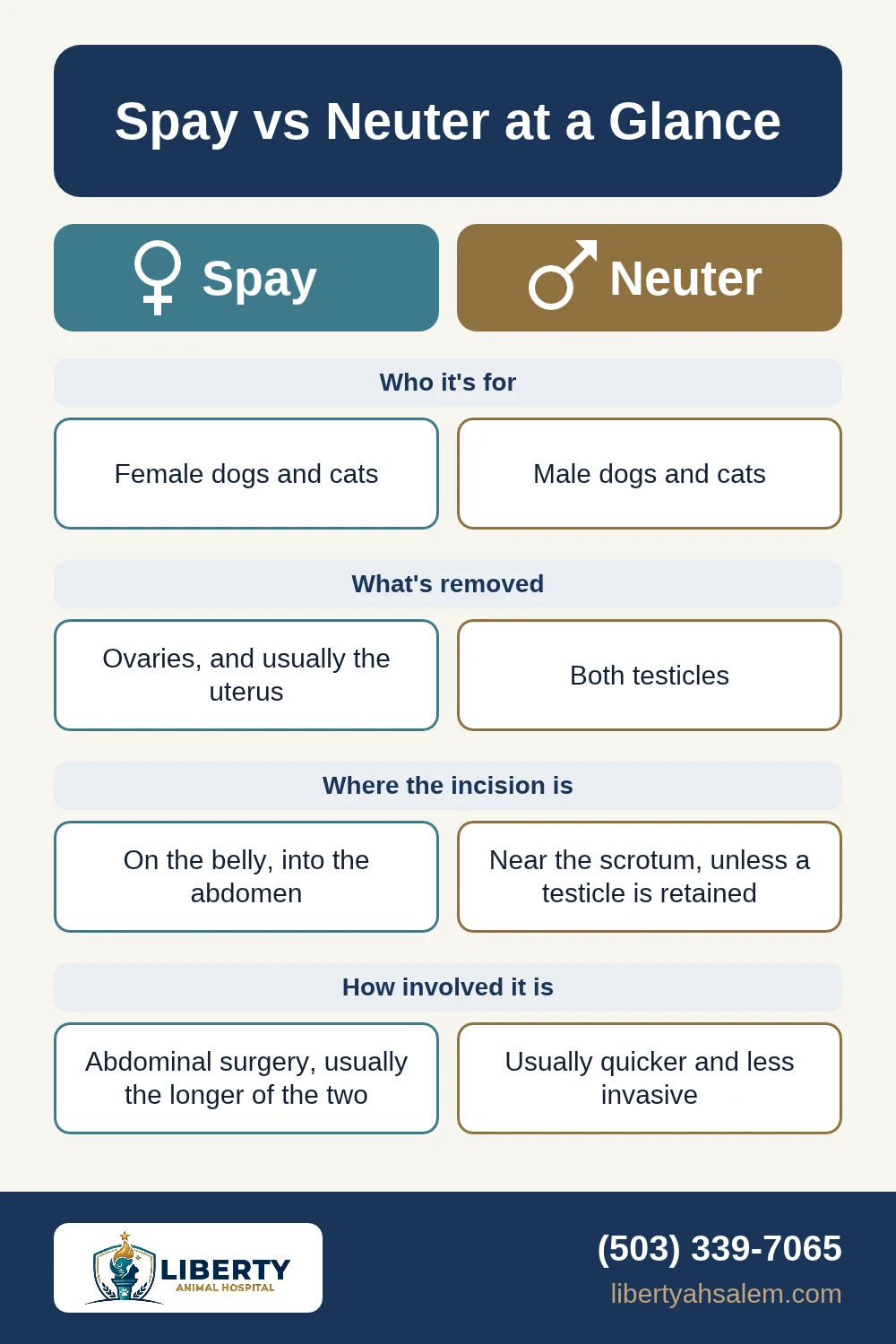
A spay is usually the bigger of the two surgeries, because the vet has to enter the abdomen to reach the ovaries and uterus. The table below shows how a spay and a neuter generally compare.
| Feature | Spay | Neuter |
|---|---|---|
| Who it's for | Female dogs and cats | Male dogs and cats |
| What's removed | Ovaries, and usually the uterus | Both testicles |
| Where the incision is | On the belly, into the abdomen | Near the scrotum, unless a testicle is retained |
| How involved it is | Abdominal surgery, usually the longer of the two | Usually quicker and less invasive |
| Main health benefits | Prevents uterine infection, lowers breast cancer risk, ends heat cycles | Removes testicular cancer risk, lowers the risk of an enlarged prostate |
| Recovery at home | Strict rest in the first week to protect the belly incision | Same incision care; many males bounce back sooner |
Both surgeries need the same basics afterward: rest, pain medicine as prescribed, and an incision your pet can't lick. Because a spay opens the abdomen, Cornell's Feline Health Center advises keeping a spayed cat as quiet as possible for a week or so, so the incision doesn't herniate.
Health Benefits of Spaying and Neutering
The health benefits of spaying and neutering go beyond preventing litters. The AVMA notes that studies have repeatedly shown spayed and neutered dogs and cats live longer on average, likely because of the health and behavioral benefits. Here's what each surgery protects against.
Benefits of spaying a female dog or cat
Spaying a female dog or cat prevents uterine infection (pyometra), which can be life-threatening and usually means emergency surgery. It also lowers the risk of breast (mammary) cancer, which AAHA notes is fatal in about 50% of dogs and 90% of cats. And it ends heat cycles, with the yowling, restlessness and bloody discharge that come with them. The AVMA says there's no known benefit to waiting until after a first heat, and AAHA notes kittens can go into heat as young as four months.
Benefits of neutering a male dog or cat
Neutering a male dog or cat removes the risk of testicular cancer, and the AVMA says it lowers the risk of an enlarged prostate. AAHA adds that it reduces roaming to find a mate, marking inside the home and fighting with other males, and in male cats it links neutering by five months with much less spraying.
Neutering isn't a training plan, though. If fear, anxiety or house-soiling continues after surgery, a visit focused on behavior can look for a medical cause first and then build a plan for home.
The “one litter first” myth
The “one litter first” myth says a female should have a litter before she's spayed. AAHA's answer to that, and to the worry that a male will feel less like himself after a neuter, is that animals simply don't think that way. A litter brings the risks of pregnancy and birth, plus finding a home for every puppy or kitten.
Risks and Trade-Offs to Talk Over With Your Vet
The risks of spaying and neutering are real but usually low. The AVMA groups them into two kinds: the surgery and anesthesia, and the hormone changes that follow.
Surgery and anesthesia risks
Surgery and anesthesia risks come with any operation, but the AVMA says they're typically low for a spay or neuter. At Liberty Animal Hospital, we lower them with a pre-surgical exam, recommended pre-anesthetic bloodwork that checks organ function, and monitoring of heart rate, oxygen levels and temperature throughout. We won't rush an elective surgery if your pet is ill or their vaccines aren't complete.
Weight gain after surgery
Weight gain after surgery is the most common long-term trade-off. The AVMA says spayed and neutered dogs and cats are more at risk of becoming overweight. Measuring meals and keeping your pet active usually handles it, and nutritional counseling can help if the scale starts creeping up.
Joint disease, certain cancers and incontinence in some dogs
In dogs, the AVMA lists urinary incontinence in spayed females, certain cancers and joint disease as other possible risks. AAHA points to University of California, Davis research, starting with a 2013 golden retriever study in which early sterilization appeared to raise the risk of problems such as cruciate ligament rupture, hip dysplasia and some cancers. AAHA says later research shows timing isn't one-size-fits-all, which is why large-breed dogs get different advice. For cats, the AVMA says there's no evidence of harm related to the age at surgery.
When to Spay or Neuter Your Dog or Cat
When to spay or neuter depends on your pet's species and, for dogs, on expected adult size.
Cats: by five months
Cats should usually be spayed or neutered by five months of age, a timeline supported by the AVMA, the American Association of Feline Practitioners and the Association of Shelter Veterinarians. AAHA endorses the same “Fix Felines by Five” approach and says kittens fixed at this age bounce back from surgery quickly.
Small-breed dogs
Small-breed dogs, those expected to weigh under 45 pounds as adults, are usually neutered at about six months or spayed before their first heat, at five to six months, under AAHA's Canine Life Stage Guidelines.
Large-breed dogs
Large-breed dogs, those expected to weigh more than 45 pounds as adults, are usually neutered after they stop growing, which AAHA says is typically between nine and fifteen months. For large-breed females, AAHA gives a window of five to fifteen months, and your vet narrows it based on your dog's risks and lifestyle.
Factors that can change the timing
Factors that can change the timing include breed, sex, health and home life, and the AVMA says the best timing for a dog is as individual as the dog. Your vet may adjust it for:
- Your dog's breed and expected adult size
- Any current illness that should clear up first
- Whether the puppy or kitten vaccine series is finished
- Other unaltered pets in your home
- A retained testicle, which changes the surgery plan
At Liberty Animal Hospital, Dr. Kolby Virgin talks through timing during preventative care visits or a dedicated pre-op visit, so you understand the benefits and risks for your own pet.
What Happens on Spay or Neuter Day at Liberty Animal Hospital
Spay or neuter day at Liberty Animal Hospital follows the same steps for both surgeries.
Before surgery
Before surgery, we go over fasting and drop-off instructions when you book, so follow them exactly. Tell us about any vomiting, coughing, diarrhea or new medications beforehand, because an unwell pet shouldn't have anesthesia for an elective surgery. If your pet eats overnight by mistake, call (503) 339-7065, since we may need to reschedule. After drop-off, your pet has a pre-surgical exam, and we recommend a pre-anesthetic blood panel.
During surgery
During surgery, your pet is under general anesthesia and closely monitored, with pain control built into the plan. If you'd like microchipping, a chip can often be placed while your pet is asleep, so ask when you schedule. Our guide to pet microchipping explains how chips and registration work.
Going home
Going home usually happens the same day: most spay and neuter patients are discharged once their recovery is stable. You'll leave with written instructions on activity limits, incision checks, pain medication from our pharmacy when it's prescribed, and when to call us. Pricing is based on your pet's weight and the procedure, and we give you an estimate before surgery day.
Spay vs Neuter Recovery: What to Expect at Home
Spay vs neuter recovery follows the same basic plan: rest, pain medicine as prescribed, and a protected incision. Because a spay is abdominal surgery, females usually need stricter rest in the first week, while many males feel like themselves sooner. Your discharge instructions always come first.
A typical recovery timeline
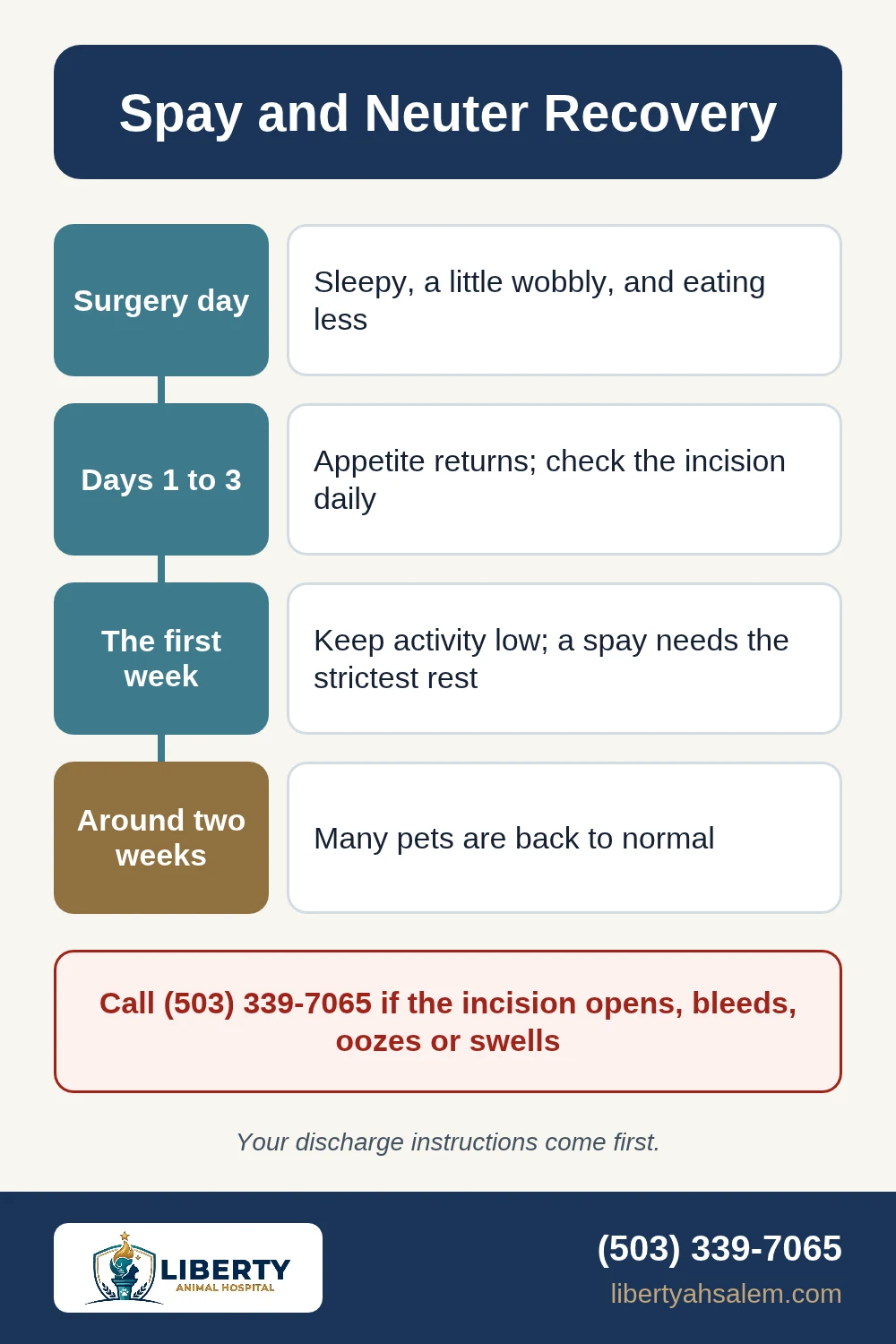
A typical recovery timeline runs about two weeks, based on the American College of Veterinary Surgeons (ACVS) and Cornell's Feline Health Center:
- Surgery day
- Sleepy, a little wobbly, and eating less. The ACVS says skipping a meal on the first day after surgery is normal.
- Days 1 to 3
- Appetite returns; check the incision daily. Mild redness or bruising can be normal at first.
- The first week
- Keep activity low; a spay needs the strictest rest. Dogs go out on a leash for bathroom breaks only, and cats stay in a small, quiet room.
- Around two weeks
- Many pets are back to normal. Skin stitches, if any, are removed at the clinic, while buried stitches dissolve. Return to full activity when your vet says so.
Home care tips for both surgeries
Home care for both surgeries comes down to protecting the incision, following ACVS guidance:
- Keep the cone or recovery suit on as directed, because licking can delay healing and invite infection.
- Check the incision once a day, and take a photo to track changes.
- No baths, swimming, ointments or sprays on the incision unless your vet says so.
- Give pain medicine exactly as prescribed, and never give human pain medicine.
- Use food puzzles and quiet attention to keep a bored pet calm.
When to call us after surgery
Call us after surgery if the incision opens, bleeds, oozes or swells, or if your pet isn't getting better. Reach us at (503) 339-7065 while we're open for any of these:
- Redness or swelling that gets worse instead of better
- Ongoing discharge, pus or a bad smell from the incision
- Not eating after the first day, or repeated vomiting
- Low energy that isn't improving, or signs of pain
If your pet is in severe distress after we've closed, such as heavy bleeding, collapse, pale gums or trouble breathing, go to a 24-hour emergency hospital. The one we direct clients to is WilVet Salem Emergency, (503) 741-8858.
Booking Spay or Neuter With a Veterinarian in Salem, OR
Booking spay or neuter with a veterinarian in Salem starts with a phone call or an online request. Liberty Animal Hospital is a dog and cat clinic on Liberty Rd S in South Salem's Sunnyslope Center, caring for pets from Salem, Keizer, Turner and Independence. If you've been searching “spay and neuter near me” or for a vet near me in South Salem, we'll talk through timing, preparation and the estimate with you first.
Call (503) 339-7065 or book an appointment online. For a new puppy or kitten, puppy and kitten care visits are a natural time to plan the surgery around the vaccine series. Still comparing clinics? Our guide to the best vet near me in Salem covers what to check. Liberty is a day clinic, so if a problem comes up after surgery once we've closed, go to WilVet Salem Emergency at (503) 741-8858.
Knowing the difference between spay and neuter is the easy part; choosing the right time for your pet is a decision we're glad to make with you.
Frequently Asked Questions
What is the difference between spay and neuter in cats and dogs?
The difference between spay and neuter is the same in cats and dogs: a spay removes a female's ovaries and usually her uterus, and a neuter removes a male's testicles. Both prevent litters and remove the main source of sex hormones. A spay is abdominal surgery, so it's usually the bigger of the two. Timing differs more by species, since cats are usually done by five months and dogs on a more individual schedule.
Does spay or neuter surgery hurt my pet?
Spay or neuter surgery doesn't hurt during the procedure, because your pet is under general anesthesia, and the AVMA notes that medications are given to minimize pain. Some soreness afterward is normal, which is why pain medicine is often sent home even when a pet seems comfortable. Give it exactly as directed. Never give human pain relievers, which can be toxic to dogs and cats, and call us if your pet seems to be hurting.
What age should I spay or neuter my puppy or kitten?
Most kittens should be spayed or neutered by five months of age, a timeline supported by the AVMA, AAHA and the American Association of Feline Practitioners. For puppies, AAHA's guidelines depend on expected adult size: dogs under 45 pounds at about six months or before the first heat, and larger dogs after they stop growing, often between nine and fifteen months. Your vet will fit the timing to your puppy's breed, sex and health.
Will spaying or neutering change my pet's behavior?
Spaying or neutering mainly changes hormone-driven behaviors, according to the AVMA: females stop having heat cycles, and males usually roam and urine-mark less. It won't erase habits your pet has already learned, and it isn't a replacement for training. Some changes can fade gradually rather than overnight. If fear, anxiety or house-soiling continues after surgery, book a visit so we can check for medical causes and help you make a plan.
Can an adult dog or cat still be spayed or neutered?
An adult dog or cat can usually still be spayed or neutered, and AAHA notes that older pets who are spayed or neutered can avoid various cancers and infections. Adult pets get the same pre-surgical exam, and we recommend pre-anesthetic bloodwork to check organ function first. If your pet has other health conditions, your vet will weigh the benefits against the anesthesia risk before recommending surgery and explain the plan with you.
How much does it cost to spay or neuter a pet in Salem?
The cost to spay or neuter a pet at Liberty Animal Hospital in Salem depends on your pet's weight and the type of procedure. We give you an upfront estimate before surgery day, which typically includes the procedure, anesthesia and expected medications. Optional pre-op lab work, or anything extra we find, is discussed with you before it's added. Call (503) 339-7065 to ask for an estimate and about payment options.
Sources
- American Veterinary Medical Association, Spaying and neutering
- American Animal Hospital Association, When should I spay or neuter my pet? (updated February 5, 2026)
- Cornell Richard P. Riney Canine Health Center, Cryptorchidism in dogs (retained testicle) (updated October 16, 2026)
- Cornell Feline Health Center, Spaying and Neutering
- American College of Veterinary Surgeons, Postoperative Care After Surgery: What Animal Owners Should Expect
Links checked . This article is general information, not a diagnosis; call your veterinarian about your own pet.