
In this article

Pet microchipping gives your dog or cat a permanent ID that stays put when a collar slips off or a cat darts out the door. The chip is tiny, but it only brings a lost pet home if it's registered to you and your contact details are current. If you've been searching for a veterinarian near me in Salem, Liberty Animal Hospital is a dog and cat clinic in South Salem. We place microchips, scan them before you leave, and help you sort out registration. This guide covers how a microchip works, the visit itself, registration in the USA, and why every dog and cat should have one.
What Is Pet Microchipping?
Pet microchipping is placing a tiny ID chip just under your pet's skin. If your pet is ever lost, a vet or shelter can scan the chip and use it to reach you. The American Veterinary Medical Association (AVMA) describes the chip as a glass-sealed electronic device about the size of a large grain of rice. It has no battery. It stays switched off until a scanner passes over it, and then it sends back a unique ID number.
That number is the whole job. The chip doesn't hold your name, your address or your pet's medical records. Instead, the number is linked to your contact details in a registry, which is a database run by a microchip company or another registration service.
What a microchip can and can't do
A microchip can identify your pet for life, but it can't show anyone where your pet is right now. Here's what you can count on, and where the limits are:
- It gives your pet a permanent ID that can't fall off or be pulled off like a collar.
- Vets, shelters and animal control can read it with a handheld scanner.
- It's designed to last your pet's lifetime, with no battery to replace.
- It can't track your pet's location, because it isn't a GPS device.
- It doesn't store your personal details or your pet's medical records.
- It can't reach you if it was never registered or your phone number is out of date.
How Pet Microchipping Works: The Chip, the Scanner and the Registry
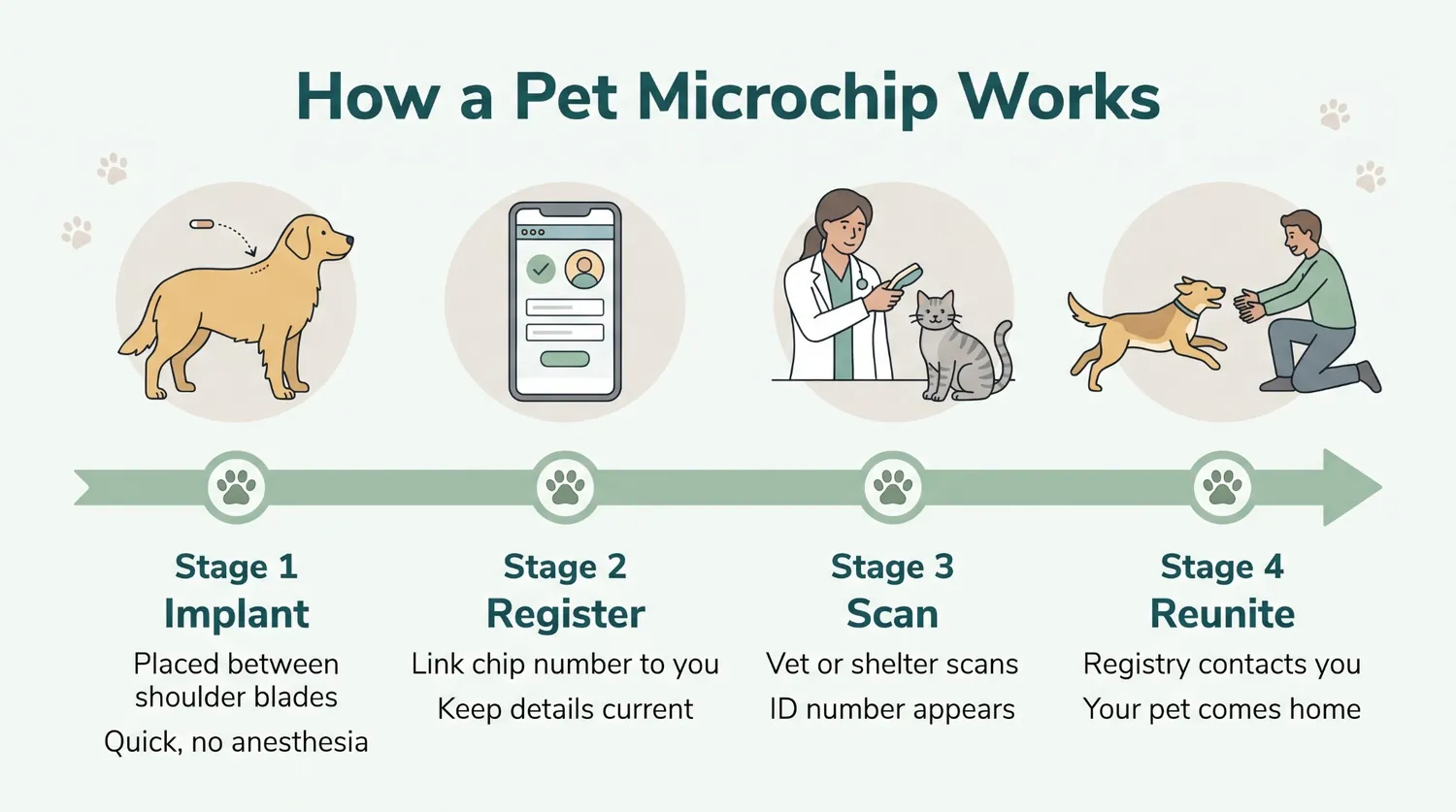
Pet microchipping works through three parts: the chip in your pet, a scanner at a clinic or shelter, and a registry that holds your contact details. If any one of the three fails, the system can't do its job. The chip and scanner rarely fail. The weak link is usually the registry, and that's the part you control.
The chip
The chip sits just under the skin, usually between the shoulder blades. In the United States, vets use this same spot on almost every pet, so anyone scanning knows where to look first. Each chip carries an ID number that's usually 9, 10 or 15 digits long. Some newer chips can also report your pet's body temperature, but their main job is still identification.
The scanner
The scanner sends out a weak radio signal that wakes the chip, and the chip's number appears on the scanner's screen. Pet microchips in the U.S. run on one of three radio frequencies: 134.2 kHz, 125 kHz or, less often, 128 kHz. The 134.2 kHz chips meet the international ISO standard and use 15-digit numbers. According to the AVMA, most vet clinics, shelters and animal control agencies now use universal scanners that read all three.
Scanning isn't perfect, though. The AVMA notes that a wiggly pet, matted fur, extra fat or a metal collar can make a chip harder to find. That's why a good scan covers the whole body, not just the shoulders.
The registry
The registry is the database that links your pet's chip number to your name, phone number, email and address. Without it, the number on the scanner is just a string of digits. A shelter that finds the chip contacts the registry, and the registry contacts you or helps put you in touch.
Why Every Pet Needs a Microchip
Every pet needs a microchip because collars and tags can come off. When they do, a chip might be the only way a shelter can find you. Collars snap, slip over a narrow head, or simply aren't on when a pet bolts out the door. A chip can't fall off or fade.
The research backs this up. A national study led by Ohio State University tracked microchipped animals at 53 shelters in 23 states. Microchipped dogs went home to their owners about two and a half times as often as stray dogs overall. For microchipped cats, the rate was about 20 times higher. Shelters found the owners of almost three out of four microchipped animals. The study dates from 2009, but it's still one of the clearest looks at what chips do for lost pets.
The indoor cat myth
Indoor cats need microchips too, because the day an indoor cat gets out is usually a day nobody planned for. A torn window screen, a door left open during a delivery, or a carrier that pops open in a parking lot is all it takes. Many indoor cats don't wear collars at all, so a chip may be their only ID. In the Ohio State study, the jump in returns was far bigger for chipped cats than for chipped dogs.
Why your pet still needs a collar and tags
Your pet still needs a collar and tags because anyone who finds your pet can read a tag right away, without a scanner. The AVMA is clear that a microchip doesn't replace ID tags or a rabies tag. A neighbor who finds your dog on the sidewalk can call the number on the tag in minutes. The chip is the backup for when the collar is gone.
If you live in Marion County, your dog also needs a county license. Marion County Dog Services requires residents to license their dogs, and says lost dogs wearing current license tags are more likely to make it home. A microchip doesn't replace that license.
When to Microchip Your Dog or Cat
The easiest time to microchip your dog or cat is during a visit you already have planned. It takes only a few minutes and doesn't need anesthesia, so it fits into most routine appointments, including a yearly wellness exam. Your vet may suggest a microchip in these situations:
- Puppies and kittens, once they're big enough for a comfortable implant, often during puppy and kitten visits
- Pets having spay or neuter surgery, since the chip can be placed while they're already asleep
- Newly adopted pets, to confirm a chip is there and get it registered in your name
- Adult dogs and cats that were never chipped
- Indoor cats that could slip out an open door or window
- Pets heading overseas, since many countries require a 15-digit chip
- Pets about to move to a new home, when doors stay open and routines change
If you're planning international travel, ask about the chip early. The AVMA notes that many countries require dogs and cats to have a 15-digit chip before they can enter. It also notes that all dogs returning to the U.S. need a microchip, which must be readable by a universal scanner. We can check your pet's chip during the exam for travel health certificates, so the number matches your paperwork.
What Happens at a Pet Microchipping Appointment
A pet microchipping appointment takes a few minutes: your vet scans first, places the chip with a needle, then scans again to make sure it reads. Most pets are awake the whole time and go home right after. Here's what to expect at each step.
Before: checking for an existing chip
Before placing a new chip, your vet scans your pet to check whether one is already there. This matters most for adopted pets, since many shelters chip animals before adoption. At Liberty Animal Hospital, we scan first so you don't pay for a second chip your pet doesn't need. If you have adoption papers or an old chip number, bring them along.
During: placing the chip
During the visit, the chip goes just under the skin between the shoulder blades, through a sterile needle that comes preloaded with the chip. The AVMA says it's no more painful than a typical shot, although the needle is a bit larger than a vaccine needle. Your pet doesn't need surgery or anesthesia. Most pets feel only brief discomfort, and many barely notice it.
If your pet is already scheduled for anesthesia, such as for spay or neuter surgery, the chip can often be placed while they're asleep. Just ask when you book, so it's part of the plan and the estimate.
After: scanning and getting the number
After the chip is in, we scan it to confirm the number reads correctly before you leave the exam room. You'll get the chip number, which you need to register it. Save it with your pet's records and in your phone.
Most pets act like themselves again right away. Keep an eye on the spot where the chip went in. If you see oozing or swelling there, call your vet right away, as the AVMA advises.
Microchip Registration in the USA: How It Works
Microchip registration in the USA runs through private registries, because the country doesn't have one central database for pet microchips. The AVMA confirms this, and it means each registry keeps its own records. Your pet's chip may be registered with one registry or with more than one. Most owners register with the company that made the chip, but other registries exist, and some shelters keep their own.
Registration is where most chips fall short. In the Ohio State study, the biggest reason shelters couldn't reach an owner was a wrong or disconnected phone number. Other common reasons were chips that were never registered and chips registered somewhere other than the maker's registry. The chip worked fine in those cases. The paperwork didn't.
How to register your pet's microchip, step by step
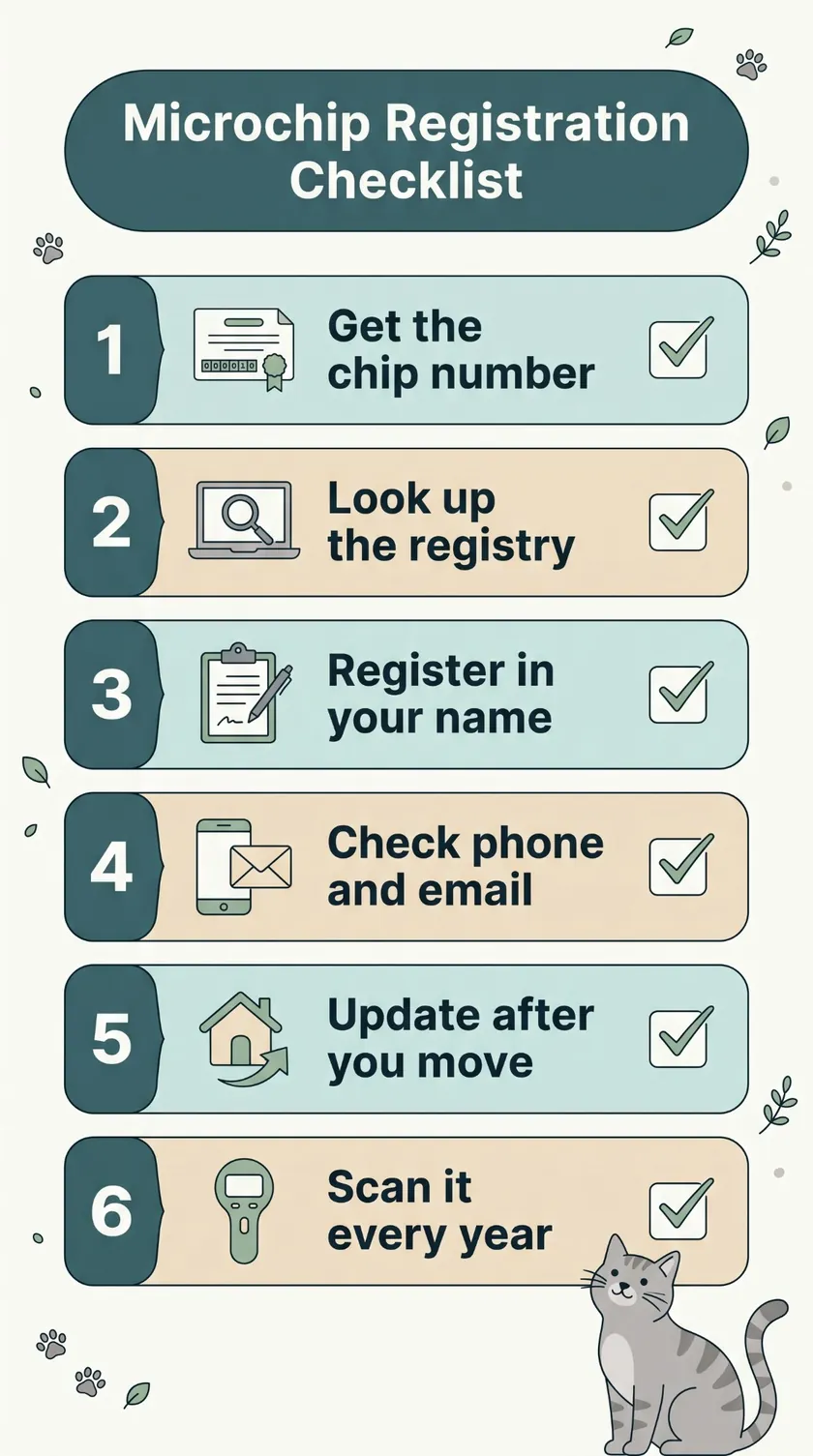
Registering your pet's microchip comes down to four steps:
Get the chip number.
It's on your vet or shelter paperwork. If you can't find it, ask your vet to scan your pet.
Find the right registry.
Enter the number in the AAHA Microchip Registry Lookup Tool, run by the American Animal Hospital Association. It lists the registries linked to that chip. Start with the first one listed, which is the most recent.
Create an account and register.
Add your pet's details and your contact information. Double-check your phone number, email and address.
Save your login.
Keep the registry name, your login and the chip number together, so updating later is easy.
Some registries charge a fee and others are free, so check before you sign up. The AAHA tool only points you to the right registry. It doesn't show owner details or let you change anything, and AAHA doesn't run any registry itself.
Keeping your registration current
Keeping your registration current means updating the registry any time your phone number, email or address changes. Do it right away after a move or a new phone number, not at the next vet visit. If you rehome your pet, help the new family transfer the chip into their name.
The AVMA suggests asking your vet to scan the chip at least once a year, which fits easily into a yearly checkup. August 15 is Check the Chip Day, a handy yearly reminder to log in and check your details. One more thing worth checking: AAHA reports that the Save This Life registry has shut down. If your pet's chip was registered there, you may need to register it with another company.
If your pet came with a chip
If your pet came from a shelter, rescue or breeder with a chip already in place, it may still be registered to them. Ask for the chip number and how the registration was set up. Then register it or transfer it into your name. If your pet has two chips, the AVMA says they won't interfere with each other, but you should keep both registrations up to date.
Microchip vs Collar Tag vs GPS Tracker: How They Compare
A microchip, a collar tag and a GPS tracker each do a different job, and they work best together. The table below shows how the three options generally compare.
| Feature | Microchip | Collar ID tag | GPS tracker |
|---|---|---|---|
| What it does | Links a scanned number to your contact details | Shows your name and phone number to anyone | Shows your pet's location on your phone |
| Can it come off? | No, it sits under the skin | Yes, with the collar | Yes, with the collar |
| Who can read it | Vets, shelters and animal control, with a scanner | Anyone who finds your pet | You, through an app |
| Power and upkeep | No battery; keep your registration current | Replace when worn or out of date | Needs charging; many need a paid plan |
| Best for | Permanent backup ID | A quick return by a neighbor | Searching for a pet that just got out |
The AVMA's advice is a registered microchip plus a collar with current ID tags, and that combination covers most lost-pet situations. A GPS tracker is a helpful extra for dogs that roam or cats that go outdoors. It doesn't replace the other two, because it only works while the collar stays on and the battery is charged.
Is Pet Microchipping Safe? Side Effects to Know About
Pet microchipping is safe for the vast majority of dogs and cats, and the AVMA says complications are uncommon. The most common issue is migration, which means the chip moves away from where it was placed. In most cases that doesn't affect your pet's health, though it can make the chip harder to find without a full-body scan.
Other problems are less common. They include a chip that stops working, and hair loss, infection or swelling near the spot where it went in. You may have read about tumors linked to microchips. The AVMA says these reports are extremely rare in dogs and cats, and no cause-and-effect link has been shown. In its view, the benefits of microchipping far outweigh the risks for the vast majority of pets.
Why a vet should place the chip
A vet should place the chip because it has to sit at the right spot and depth to be read for life. Chips are sold online, but the AVMA warns that a chip placed wrong can be hard to find and can sometimes cause injury. It recommends that chips be placed by a veterinarian or under a vet's supervision. Your vet can also spot and treat any problem early.
If you notice oozing or swelling where the chip went in, call us at (503) 339-7065 during open hours. If your pet seems very unwell once we've closed, go to a 24-hour emergency hospital. The one we direct clients to is WilVet Salem Emergency, (503) 741-8858.
Getting Pet Microchipping Near Salem
You can get pet microchipping near Salem at Liberty Animal Hospital, our dog and cat clinic on Liberty Rd S in South Salem's Sunnyslope Center. If you've searched “pet microchipping near me” after adopting a pet, we can add a chip to a wellness, vaccine, or puppy and kitten visit. We can also include it in spay or neuter plans when it's appropriate. If your pet may already be chipped, we scan first, and we confirm a new chip reads before you leave.
We quote the microchip fee when you schedule or at the visit. Registration fees, if any, depend on the registry and are separate. To set up a visit, book an appointment online or call (503) 339-7065. And if you're still comparing clinics, our guide to finding the best vet near me in Salem covers what to check before you choose.
Pet microchipping takes a few minutes, but a current registration is what turns that tiny chip into a way home.
Frequently Asked Questions
Does pet microchipping hurt?
Pet microchipping hurts about as much as a routine shot, and most pets feel only brief discomfort. The needle is a little larger than a vaccine needle, so some pets may flinch for a second. It doesn't need surgery or anesthesia, and most dogs and cats act like themselves again right away. If your pet is already booked for spay or neuter surgery, ask whether the chip can be placed while they're asleep.
How long does a pet microchip last?
A pet microchip is designed to last your pet's whole life. It has no battery, so it usually doesn't wear out or need replacing. In rare cases a chip can stop working or move from where it was placed. That's why the AVMA suggests having your vet scan the chip at least once a year. A quick scan at your pet's yearly checkup confirms the chip is still there and still reads.
Can pet microchipping track my pet's location?
Pet microchipping can't track your pet's location, because a microchip isn't a GPS device. The chip has no battery and only sends out its ID number when a scanner passes over it up close. It helps once someone finds your pet and takes them to a vet or shelter. If you want live location tracking, you'd need a separate GPS tracker on the collar, which works best alongside a registered microchip.
How do I find my pet's microchip registration in the USA?
The easiest way to find your pet's microchip registration in the USA is to enter the chip number in the AAHA Microchip Registry Lookup Tool. It lists the registries linked to that number, starting with the most recent. The tool won't show owner details or let you make changes, so you'll need to contact the registry directly. If you don't know the chip number, ask your vet to scan your pet and read it to you.
How old should a puppy or kitten be for pet microchipping?
Puppies and kittens can have pet microchipping once they're big enough for a comfortable implant, which your vet will judge at an early visit. Many owners add it to a puppy or kitten vaccine appointment. Others have it done during spay or neuter surgery, while the pet is already asleep. Young pets slip through gates and doors too, so getting the chip in early means they're covered from the start.
Do indoor cats need pet microchipping?
Indoor cats need pet microchipping because they can get out through an open door, a torn screen or a carrier that pops open. Many indoor cats don't wear collars, so a chip may be the only way a shelter can find their owner. In a national study of shelters, microchipped cats went home about 20 times as often as stray cats overall. A chip is a quick, one-time step that covers your cat if the unexpected happens.
What should I do if my microchipped pet goes missing?
If your microchipped pet goes missing, first check that your registry contact details are correct, and fix them right away if not. Then call local shelters, animal control and nearby vet clinics, and give them your pet's description and chip number. In Marion County, you can post a lost dog on the county Dog Services website. Keep checking found-pet listings, and visit shelters in person if you can.
Sources
- American Veterinary Medical Association, Microchipping: FAQs for pet owners
- American Veterinary Medical Association, Microchips reunite pets with families
- American Animal Hospital Association, Pet Microchip Registry Lookup
- The Ohio State University, Microchips Result in Higher Rate of Return of Shelter Animals to Owners (October 11, 2009)
- Marion County Dog Services, Lost and Found Dogs
Links checked . This article is general information, not a diagnosis; call your veterinarian about your own pet.